
October 31, 1928 – May 20, 2026
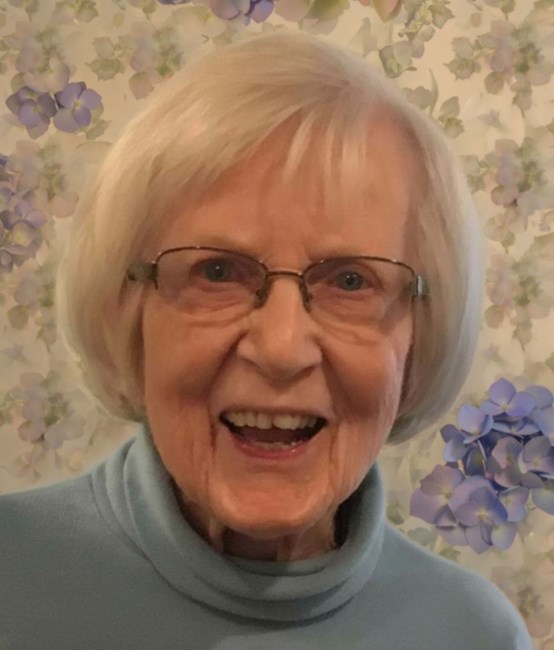
Joan Therese Batting Dowd passed peacefully into the loving arms of Our Heavenly Father on Wednesday, May 20, 2026. She had been receiving hospice care for several weeks after living with Parkinsonism and breast cancer for many years.
Joan is survived by her two sons and their families – John Joseph Pierre Dowd, Jr., his wife Kara, and their children Anna, John, Nora and Elsa; and Christopher Patrick Dowd, his wife Clare, and their children Emma, Thomas, and Maeve. In addition, she is survived by her brother Bruce Batting and her nephews Steven, William, and Jonathan Batting. Her husband John Joseph Pierre Dowd, Sr. (“Pierre”), brother Robert Batting, and niece Susan Batting predeceased her.
A Funeral Mass will be held on Friday, June 12 at 10:30 am at Holy Trinity Catholic Church, 1315 36th Street, NW, Washington, DC, with a livestream available. A wake and visitation with the family will be held on Thursday, June 11 from 5-8 pm at Joseph Gawler’s Sons funeral home at 5310 Wisconsin Avenue, NW, Washington, DC. Burial will be at West Cemetery, Boston Post Road, in Madison, Connecticut, on Friday, July 17.
Donations in lieu of flowers may be made to Association Montessori Internationale, St. Mother Xavier Cabrini Ministry at Shrine of the Sacred Heart, or Holy Trinity Catholic Church Social Justice Ministry.
The Dowd family extends its deepest gratitude to the staff and aides at Brightview Grosvenor Assisted Living, BrightStar Care, RenewMe Fitness, Jewish Social Services Agency, Kensington Park Independent Living, and Debra Levy Eldercare. They provided a warm and loving environment that respected and preserved Joan’s dignity as she progressed through her debilitating illnesses.
The family is also grateful to the many Eucharistic ministers from Holy Trinity Catholic Church who brought communion and shared each week’s liturgical readings with Joan and her husband, Pierre.
The family is also grateful to the many nurses and doctors at MedStar Georgetown University Hospital’s Department of Neurology, Virginia Cancer Specialists, Suburban Hospital, and VHC Health for the excellent care they provided to Joan.
Joan Therese Batting Dowd was born on October 31, 1928, in Malden, Massachusetts, the daughter of Joseph Raymond Batting and Frances Gertrude Savage. Her father was a civil engineer who studied at Lowell Institute School, the night school of MIT, in Cambridge, Massachusetts. Growing up in the depths of the Great Depression, Joan’s family moved frequently, including three times while she attended first grade, as the family followed the few infrastructure projects available to employ her father. “Sometimes you have to go where the jobs are,” her father often explained.
Her family eventually settled in Norris, Tennessee, where her father worked for several years designing dams and bridges as part of the Tennessee Valley Authority program that brought electricity to rural households. Her family returned to the Boston area as Joan entered high school, and Joan graduated from Reading High School.
Joan attended Beaver College (now called Arcadia University) in Pennsylvania but took one year of absence to earn enough money to pay for her tuition. After receiving her B.A. in Sociology, she worked in Lowell, Massachusetts as a social worker assisting new immigrants from Portugal, and later with tuberculosis patients.
Although Joan was raised in a Unitarian household, she felt a calling for a more spiritual life, and to the surprise and consternation of many family members, she converted to Catholicism in the early 1950s while a parishioner at the Paulist Center in Boston, Massachusetts. Her best friend, Mary T. Sullivan of Cambridge, Massachusetts, was her sponsor during Joan’s religious education. The writings of Thomas Merton were some of Joan’s favorites and inspired her to become a Roman Catholic.
Eager to travel internationally, she joined the U.S. State Department in Washington, DC, and then worked at the U.S. Embassy in Santiago, Chile for several years in the 1950s and later in England. She traveled alone in her spare time throughout South America including Peru and Columbia, an experience that was many years ahead of her time. Throughout her life, Joan spoke fondly of the different cultures she met and how she loved sharing a common Roman Catholic faith with them.
After returning to Washington, DC, Joan worked in 1958 for the Draper Committee, a bipartisan committee created by President Dwight D. Eisenhower to undertake an independent and non-partisan analysis of the effectiveness of military assistance programs over the previous decade. Later she joined the Institute for Defense Analysis (“IDA”), one of the earliest “think tanks” in DC, and it was there that she met her future husband, Pierre Dowd. They wed on October 26, 1963, at Annunciation Church in Washington, DC.
Joan and her family lived in the Woodley Park neighborhood of Washington, DC, and were regular parishioners of Holy Trinity Catholic Church in Georgetown. Joan loved spending time with her family, especially her husband Pierre during their 60 years of marriage. The two had a unique bond, rooted in love and support for one another as well as compassion for others. They felt an obligation to help others and frequently volunteered with groups assisting those in need particularly the homeless and refugees. They proudly recalled being at the Lincoln Memorial among the thousands who participated in the 1963 March on Washington led by Martin Luther King.
After the birth of her two sons, Joan earned her Montessori teaching degree which enabled her to pursue her greatest passion, teaching young children. She graduated from one of the first classes of teachers at the Washington Montessori Institute, the local chapter of Association Montessori Internationale. She was a primary school teacher at Aidan Montessori School for nearly a decade.
With a natural affinity for children, Joan delighted in helping children master Montessori materials and methods, while at the same time deepening their confidence and leadership skills. Dr. Maria Montessori’s belief that even a seemingly incorrigible child had the potential to master difficult material resonated deeply with Joan, for she aways saw the enormous capacity for children to learn, grow and work well with others when placed in the right environment.
In the early 1980s, Joan joined the National Academy of Sciences where she worked in the Fellowship office that administered post-doctoral awards to some of the brightest young scientists. It was here that she made close friendships with her fellow workers including Chris O’Brien, Shelly Henderson, and others. She later led the Academy’s administration of the Fellowship Program for the International Atomic Energy Administration (“IAEA”) which brought scientists from around the world to study at U.S. universities and learn peaceful applications of nuclear science in the medical and electrical power industries.
After retiring from the Academy, Joan continued her love of teaching by volunteering at the Shrine of the Sacred Heart in Washington, DC, where she taught English to new immigrants from Central and South America, Haiti, and Vietnam. She organized book donations for scientists in the newly independent country of Latvia, and traveled there with other volunteers including her husband, Pierre. Even when she and Pierre moved into independent and subsequently assisted living facilities, she worked with staff members to improve their proficiency in English.
Joan loved her children, grandchildren, and extended family immensely, and nothing made her happier than spending time with them, whether enjoying a meal together, watching them after school or on vacations, or attending one of their many sports games and music recitals. She loved hosting her children’s friends from college as they transitioned to new careers in the Washington area, and she generously opened the doors to the family’s house for months at a time.
Despite her international travels and her many years of living in Washington, DC, Joan considered herself a New Englander at heart. She was known to sometimes sneak in a Red Sox T-shirt or cap as part of a birthday present to a grandchild. She loved a good lobster roll and cup of clam chowder. In retirement, she spent more and more time at the family home in Madison, Connecticut, and enjoyed long walks along Seaview and Hammonasset Beaches. An avid gardener, she meticulously planted and pruned flowers and bushes at her home.
A quiet person by nature, Joan was never shy about voicing her own opinions, especially the need to care for those less fortunate. She understood intuitively how every life is precious and how to live the Gospel by helping others develop their own, unique talents to the fullest extent possible. Having been uprooted and forced to travel many times in her youth, she later found ways to choose her own path, first by working and traveling in South America, and later by pursuing multiple careers including teaching and program administration. As a child she experienced first-hand the potential for government to improve the lives of the distraught, and she quietly championed the sharing of scientific knowledge around the world. Her proudest accomplishment was spreading peace in her own way, one person at a time – a Montessori student, an immigrant who learned English, or a grandchild. She never stopped teaching, even in her final years of life.