More Than 1,000 First Responders Complete 35 Courses This Year
MEDFORD–More than 1,000 police, fire and EMS professionals have completed joint active shooter response training across Massachusetts this year as the Healey-Driscoll Administration expands efforts to prepare first responders to act quickly and work together during a crisis.
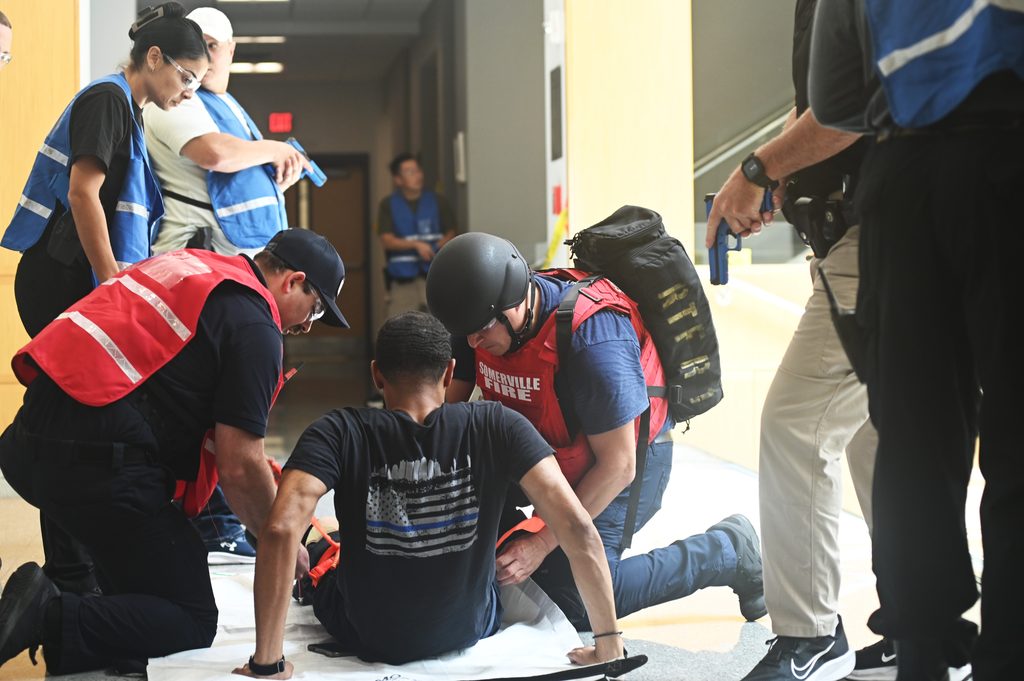
One of the latest Active Attack Integrated Response courses brought approximately three dozen first responders to Tufts University for two days of classroom instruction, hands-on exercises, and realistic scenarios. Participants included personnel from the Massachusetts State Police, Arlington Police, Lexington Police, Lexington Fire, Medford Fire, Somerville Fire, Somerville Police, Stoughton Fire, Cataldo Ambulance, and the police departments of North Shore Community College, Tufts University, and Worcester State University.
“Massachusetts was the first in the nation to adopt an internationally recognized framework for consistent, statewide active shooter response training,” said Public Safety and Security Secretary Gina K. Kwon. “Our law enforcement, fire service, EMS, telecommunicator, and emergency management personnel are training together in courses like this one so they can work together in a real-world crisis.”
The Active Attack Integrated Response (AAIR) course was coordinated by the Massachusetts Department of Fire Services, the Municipal Police Training Committee, and the Advanced Law Enforcement Rapid Response Training Center, with support from the Executive Office of Public Safety and Security.
The course was held August 18–19 in partnership with Tufts University and the Tufts University Police Department. Tufts also hosted AAIR courses in June and July.
“We significantly ramped up AAIR deliveries to meet increased demand after last winter’s active shooter event at Brown University,” said State Fire Marshal Jon M. Davine. “So far this year, we’ve delivered 35 classes for first responders across Massachusetts, from Provincetown to North Adams. That’s more than 1,000 police, fire, and EMS professionals ready to stop the killing and stop the dying.”
“The AAIR curriculum provides life-saving training to first responders at every level of experience,” said Captain Amy Fanikos (Ret.), Deputy Executive Director of the Municipal Police Training Committee. “From classroom instruction to hands-on exercises to increasingly complex scenarios, it builds the skills necessary for law enforcement and fire/rescue to work seamlessly together when every second can be the difference between life and death.”
“I received great feedback from the Somerville firefighters who took part in this course,” said Somerville Fire Chief Charles J. Breen, Jr. “It builds on many of the emergency medical skills we already use, and it provides a strong foundation for working with our police partners. Trainings like this one could help save lives in a crisis most people don’t want to contemplate.”
“Massachusetts is doing some of the most aggressive AAIR training in the country,” said John Cantarella, Northeast Regional Manager for the Advanced Law Enforcement Rapid Response Training Center at Texas State University.
In 2022, Massachusetts became the first state to adopt NFPA 3000, Standard for an Active Shooter/Hostile Event Response Program, as a statewide framework for active shooter response training through the Massachusetts Firefighting Academy, Municipal Police Training Committee and State Police Academy.
Developed following the 2016 Pulse nightclub shooting in Orlando, Florida, NFPA 3000 emphasizes the importance of law enforcement, fire, EMS, and other public safety partners planning, training, and coordinating before an emergency.
AAIR puts that framework into practice. The curriculum uses plain language and common terminology to help first responders establish command, stop an attacker, and reach injured people as quickly as possible. It also trains participants in the Rescue Task Force model, in which law enforcement protects fire and EMS personnel as they provide immediate medical care and evacuate patients.
The Department of Fire Services and Municipal Police Training Committee also offer Active Attack Incident Management, a course for chiefs and senior officers focused on command-level strategies, and Civilian Response to Active Shooter Events, which teaches civilians how to protect themselves and others until first responders arrive.
Together, these interagency training programs have reached more than 7,000 police officers, firefighters, EMS providers, public safety dispatchers, and other participants across Massachusetts.